
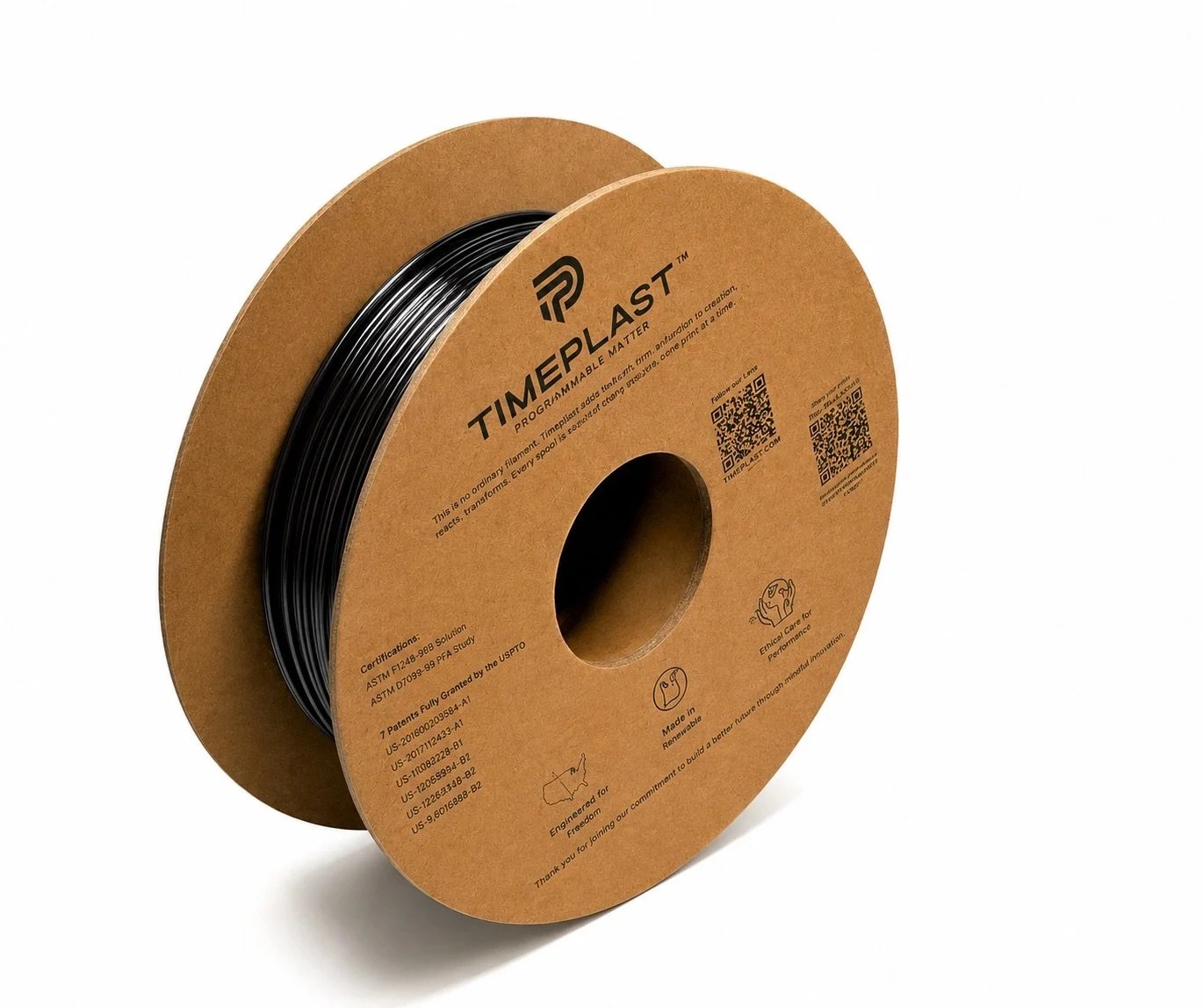
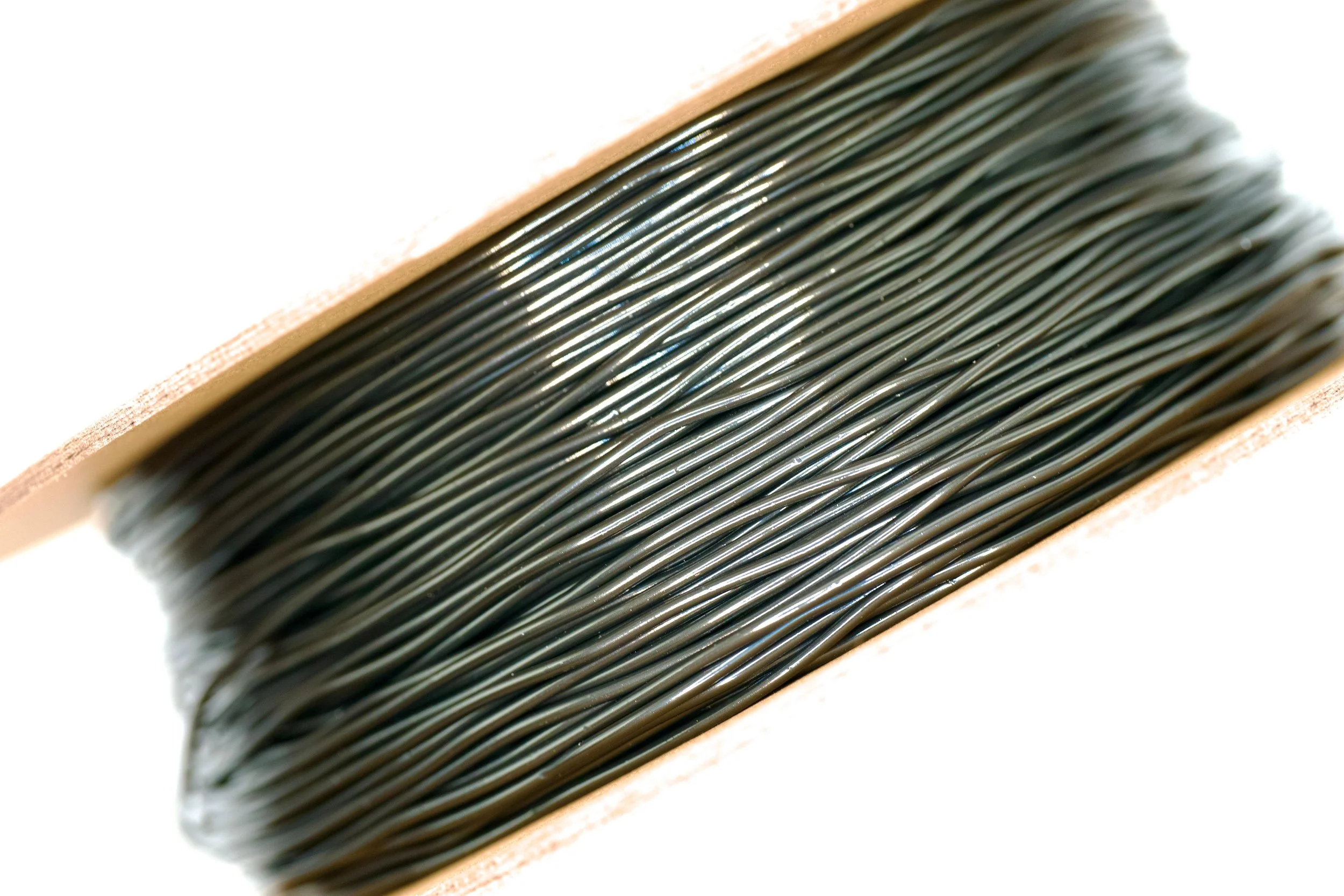
First Ever Functional 3D Printed Solar Panel!
-
Because TimeMass Photovoltaic filament contains active nanomaterials and is designed to dissolve in water, it’s important for users to follow safety precautions.
While intact filament spools and printed objects are stable to handle when dry, exposure to water will cause the filament or print to break down and release zinc oxide nanoparticles and carbon nanotubes into the liquid. These substances can pose health and environmental risks if not handled properly. We are committed to customer safety, so please observe the following guidelines when using this filament:
Store and Print with Care: Keep the filament sealed and dry during storage. The high water content means it can absorb moisture from the air and start degrading if left in a humid environment. Use a dry box or airtight container. When printing, it’s best to work in a well-ventilated area (as with any filament) to avoid any fumes or ultrafine particles. Avoid inhaling any dust that might come from handling or grinding the filament; wear a dust mask if you need to sand or cut printed pieces, as a precaution to not inhale graphite or nanotube-containing dust.
Avoid Water Contact (Unless Intentionally Dissolving): Keep printed objects away from water or high humidity during their use, unless you deliberately want to dissolve them. Water is the “trigger” that causes this material to break down. For example, do not use this filament for objects that will be outdoors in the rain or used to hold liquids, etc., without protective coatings. If the print does get wet, it will start to soften and dissolve, releasing its nanoparticle additives into the water. (Note: The dissolution is a feature for planned disposal or recycling, but accidental exposure should be avoided.)
Protective Gear During Dissolution: If you plan to dissolve a printed object (or if one accidentally dissolves), wear gloves and eye protection when handling the solution. The water that contains dissolved polymer will also contain suspended ZnO nanoparticles and carbon nanotubes, as well as fine graphite. Do not touch or ingest this residue. Zinc oxide in nanoparticle form can be harmful if ingested or absorbed in high amounts, and can cause irritation; carbon nanotubes are considered hazardous if they enter the lungs or bodily tissues. While ZnO is used in sunscreens safely, that’s in a bound context – free ZnO nanoparticles in water can release zinc ions which are toxic to marine life and possibly irritating to humans. Carbon nanotubes, due to their fiber-like shape, have been compared to asbestos in terms of potential to cause lung damage if inhaled. Therefore, avoid any direct contact with the muddy or cloudy water resulting from dissolved prints. If skin contact occurs, wash thoroughly with soap and water.
Proper Disposal of Residue: Do not pour the waste water from dissolved TimeMass Photovoltaic prints down household drains or into the ground. Instead, we recommend collecting the liquid in a container and letting the solid particles settle (you’ll see a sediment of black/white powder from the graphite and ZnO). You can then filter out the solids (using a coffee filter, for example) and dispose of them in a sealed plastic bag in the trash, or according to your local guidelines for nanoparticle or chemical waste. The filtered water (which will contain dissolved polymer and trace ions) can be disposed of, but it’s best to heavily dilute it and dispose in a sanitary sewer with lots of additional water. Never reuse the solution for any household purpose. This careful disposal prevents environmental contamination – for instance, zinc oxide nanoparticles are known to be harmful to aquatic organisms if released in significant quantities. By capturing the solids and not simply dumping them, you protect both the environment and your plumbing. (If your region has a chemical waste collection program, you could also submit the sealed residue there for safe processing.)
Keep Out of Reach of Children and Pets: Because this filament can dissolve into a potentially toxic solution, it’s important to ensure children or pets do not ingest either the filament or any part of a dissolved print. The solid filament isn’t edible (and contains chemicals like zinc compounds and ethanol-based polymers), and the dissolved mixture would taste bitter/unpleasant – but curious kids or animals should be protected nonetheless. Always store filament spools securely. If you have a dissolved mixture sitting around (for example, you are in the process of post-processing a print), keep it in a closed container that kids/pets cannot access.
Emergency Measures: In the unlikely event that someone ingests the solution or a piece of dissolved filament, seek medical attention and inform the medical professionals of the contents (zinc oxide, ethylene-vinyl alcohol polymer, and carbon nanotubes/graphite). For skin contact, rinse with plenty of water. If a lot of airborne dust is inhaled (e.g., from burning or aggressively sanding the material), move to fresh air and seek medical advice if any respiratory discomfort occurs. This formulation is not intended to be burnt – burning will release zinc fumes and other irritants; always print at recommended temperatures to avoid decomposition.
-
Click here to access our new and improved TimeMass GPT Assistant. Just tell it your printer model and the TimeMass filament you're using—it will instantly recommend the exact parameters you need to start printing successfully.
1. Introduction
These parameters are designed to help avoid printing issues; however, temperatures and speed timings can be adjusted based on your specific goals. For example, if you prefer a less rigid result, we recommend using a lower temperature. This section outlines a complete slicing and printing profile for TimeMass Photovoltaic, tailored for printers with a 0.8 mm nozzle. If the print is not being successful, please lower the nozzle temperature by 10°C and start over until an optimal print is achieved. Please check the manual for printing parameters.2. Temperature Settings
2.aNozzle Temperature: 230°C — Optimal for flowability while avoiding decomposition (which begins around 250°C).
2.bBed Temperature: 75°C — Ensures strong first-layer adhesion and prevents moisture bubbling.
2.cNozzle Temperature Range: 230–245°C — Timeplast melts around 165°C but prints best at 240°C for precise viscosity control.3. Cooling Settings
3.aNo Cooling for First Layers: 3 layers — Prevents shrinkage due to rapid cooling of moisture-rich filament.
3.bFan Minimum Speed: 0% for the first 100 seconds — Allows heat retention during early layers.
3.cFan Maximum Speed: 15% starting at 8 seconds — Avoids overcooling that can lead to warping.
3.dKeep Fan Always On: OFF — Allows vapor to escape and avoids internal fogging.
3.eSlow Down for Cooling: ON — Improves surface finish with controlled cooling.
3.fForce Cooling for Overhangs: OFF — Overcooling can deform bridges in Timeplast.
3.gFan for Overhangs: 15% — Only for essential cooling in complex areas.
3.hPre-Start Fan Time: 2 seconds — Minimizes pressure differential during the first layer.4. Volumetric Flow
4.aMax Volumetric Speed: 12 mm³/s — Based on a melt flow index of ~15 g/10min, allows high-speed printing.
4.bRamming Speed: 3 mm³/s — Prevents bubbles or popping from pressure spikes.5. Retraction and Flow
5.aRetraction Distance: 0.4 mm — Minimal retraction required for soft filaments to avoid stringing.
5.bRetraction Speed: 15 mm/s — Slow enough to avoid pulling molten plastic.
5.cPressure Advance: 0.05 — Compensates for nozzle lag at high flow rates.
5.dFlow Ratio: 92% — Slight under-extrusion avoids swelling and surface artifacts.6. Precision Settings
6.aGap Closing Radius: 0.1 mm — Tolerant of gaps in thicker walls.
6.bArc Fitting: ON — Reduces G-code size and smooths curve transitions.
6.cElephant Foot Compensation: 0.1 mm — Offsets squishing in the first layer caused by large bead sizes.7. Walls and Shells
7.aWall Loops: 2 — Minimum for strength when using a 0.8 mm nozzle.
7.bDetect Thin Walls: ON — Ensures tight geometries aren’t skipped.
7.cTop/Bottom Shell Layers: 3 — Provides good coverage; increase if watertightness is needed.
7.dTop/Bottom Thickness: 1.2 mm — Equals 1.5x the nozzle size for solid strength.
7.eTop/Bottom Pattern: Monotonic — Distributes tension evenly and improves surface finish.8. Geometry and Movement
8.aWall Order: Inner before Outer — Creates cleaner outer surfaces.
8.bInfill First: OFF — Maintains precise outer dimensions.
8.cSmooth Speed Transition: ON — Prevents ringing caused by abrupt speed changes.
8.dSmooth Coefficient: 80 — Ideal damping for soft materials.
8.eAvoid Crossing Wall: ON — Minimizes stringing across part walls.
8.fMax Detour for Crossing: 10 mm or 5% — Balances time with print cleanliness.9. Layer and Width Settings
9.aLayer Height: 0.3 mm — Optimal for strength and resolution using a 0.8 mm nozzle.
9.bInitial Layer Height: 0.35 mm — Slightly higher to improve adhesion.
9.cLine Widths (all): 0.8 mm — Matches nozzle diameter for consistent extrusion.10. Seam Settings
10.aSeam Position: Aligned or Back — Use aligned for mechanical consistency, back for visual appeal.
10.bSmart Scarf Seam: ON — Automatically adjusts seam location to reduce visual impact.
10.cSeam Angle: 155° — Standard seam angle for clean transitions.
10.dSeam Steps: 10 — Smooths seam path and improves visual finish.11. Infill Settings
11.aWall/Infill Overlap: 10% — Prevents infill from deforming soft exterior walls.
11.bInfill Combination: ON — Consolidates paths for efficiency.
11.cDetect Floating Shells: ON — Ensures unsupported vertical structures are printed reliably.
11.dSparse Infill Density: 20–25% — Balanced rigidity vs. material use.
11.eSparse Pattern: Grid — Stable and efficient for flexible geometries.12. Speed Settings
12.aTravel: 160 mm/s — Fast but safe against backlash.
12.bInitial Layer: 15 mm/s — Prevents nozzle from skimming and ensures bed adhesion.
12.cOuter Wall: 60 mm/s — Controlled speed for surface quality.
12.dInner Wall: 90 mm/s — Slightly faster without compromising control.
12.eSmall Perimeter: 35 mm/s — Reduced speed for detailed geometry.
12.fTop Surface: 40 mm/s — Improves finish on topmost layers.
12.gInfill: 100–120 mm/s — Takes advantage of high flowability.13. Acceleration Settings
13.aNormal Print: 2000 mm/s² — Prevents ringing in soft filaments.
13.bTravel: 4000 mm/s² — Enables fast movement without harsh transitions.
13.cInitial Layer: 300 mm/s² — Gentle movement prevents lifting from the bed.
13.dOuter Wall: 1500 mm/s² — Improves outer surface clarity.
13.eInner Wall: 2000 mm/s² — Balanced for structural components.
13.fTop Surface: 1500 mm/s² — Ensures smooth detailing.14. Adhesion and Brims
14.aSkirt Loops: 2 — Helps prime nozzle and start cleanly.
14.bBrim Width: 6 mm — Helps hold soft materials down.
14.cBrim Gap: 0.15 mm — Allows for easy removal without tearing.15. Prime Tower and Flush Settings
15.aPrime Tower: ON — Purges moisture and early flow inconsistencies.
15.bTower Width: 40 mm — Prevents collapse due to heat.
15.cBrim Width (Tower): 4 mm — Adds stability to the purge base.
15.dFlush Into Support: ON — Discards unwanted early flow safely.16. G-Code Start Script
M900 K0.05 ; Pressure Advance M106 S0 ; Fan off G92 E0 G1 E15 F300 ; purge line G92 E0
17. Additional Notes
17.aDry filament at 155F for 2 hours before use.
17.bStore with desiccant.
17.cKeep extruder door open to allow vapor to escape.
17.dAvoid long dwell times at high temperatures.If you need any other assistance, feel free to reach out to us anytime at timeplast@timeplast.com — we’ll be happy to help.
-
IMPORTANT:
TimeMass functional filaments are designed for advanced users, innovators, and professionals who understand and assume the risks associated with handling active or reactive materials. Some products in the TimeMass line contain biologically active, chemically reactive, or potentially toxic substances—including but not limited to: boric acid, sodium fluoride, insecticides, antifungal agents, and rodenticides.
By purchasing or using these products, you acknowledge and agree to the following:
Use Responsibly: These materials are intended for experimental, industrial, or educational purposes only. They are not toys, and should be kept out of reach of children and pets at all times.
Proper Handling Required: when using reactive filaments, always wear appropriate personal protective equipment when handling, printing, or disposing of filaments that may contain toxic or irritant ingredients. This may include gloves, masks, and adequate ventilation.
Do Not Ingest: Any food-themed or bait filaments (e.g. Fish Food, Rat Bait, Bug Attractor) are not meant for human consumption and may be toxic if ingested. Avoid all direct contact with mouth, eyes, or open wounds.
Liability Waiver: Timeplast assumes no responsibility or liability for misuse, improper handling, or unauthorized applications of these products. End users are solely responsible for evaluating the suitability and safety of the materials for their intended use.
Local Laws Apply: Always follow local regulations regarding the use of antimicrobial agents, pesticides, or bioactive substances in your region or country.
Please note: Our filaments are not vacuum-sealed, as they require drying before printing regardless of packaging. In line with our mission to eliminate plastic waste, we use 100% plastic-free packaging. Vacuum-sealed packaging is single-use and highly polluting, and goes against the environmental principles that guide everything we do at Timeplast.
Ambient humidity actually keeps them in perfect condition, giving them an unlimited shelf life. Unlike conventional filaments, which dry out over time, become brittle, and lose their thermoplastic properties, our filaments are specifically engineered to remain in optimal condition for decades—as long as they are exposed to normal humidity.
In all honesty, with TimeMass you won’t just print objects—you’ll print experiences. Think about it. By introducing a new programmable dimension, your designs don’t just sit there. They evolve. Shift. Light up. Soap up. Grow up. Phase out. Disappear and more. You’re actually building moments.
Precision? Built In.
Making a filament with Timeplast is not easy, not at all. We can’t use automated machines for example. Each spool is handcrafted, here in the U.S. and monitored by a human for over a 49-minute cycle per spool. That’s not mass production—that’s obsessive accuracy.
Specs That Actually Matter:
Diameter: All of our filaments have a diameter of Ø= 1.75 ± 0.15 mm.
Mass: 0.77lb
Compatibility: Works with all major 3D printers. No drama.
True timed obsolescence
Use filaments with built-in "time codes" like Active, Delayed or Passive to make your prints transform, separate, or self-destruct on schedule. Whether it’s art, function, or straight-up sci-fi—if you can print it, you can make it move.
Water Molecular Disintegration – Print Today, Gone Tomorrow
Yes the words “Molecular Disintegration sounded like something that ChatGPT would say, but no, it’s the only way to explain how our materials dissolve in the presence of water down to a Carbon-to-carbon level. TimeMass breaks down at the molecular level when exposed to water. That’s not marketing—it’s chemistry. Smart materials that serve their purpose, then step aside. Clean, conscious, and built for next-gen applications.
By completing your order, you consent to receive email updates related to your purchase. We may also send you promotional offers, product news, and personalised recommendations. You can opt out at any time by clicking the "unsubscribe" link in any of our emails. Your information will be handled in accordance with our [Privacy Policy].